
When you are a producer of ceramic tiles, sanitaryware, glass, glazes or any other product based on minerals, the production of raw materials influences directly the process of production.
One of the important industrial minerals is soda feldspar that is a source of sodium carrying alkali and alumina and a good flux when processed at high temperatures.
The extent of its usefulness, however, is determined by chemical composition, purity, particle size, and consistency.
That is why selecting soda feldspar suppliers is as important as understanding this mineral.
You must understand what soda feldspar is, how it functions and where it is actually used by industries before you decide on a grade to use in your manufacturing process.
What Is Soda Feldspar?
Soda feldspar, which is generally related to sodium-rich feldspar like albite, is a feldspar type of aluminosilicate mineral. Feldspars include different amounts of sodium, potassium or calcium with silica and alumina.
Soda feldspar is also appreciated in industrial usage, especially in its sodium content and the ability to flux. Its alkali content lowers the temperature at which other raw materials will melt into a glassy phase when it is heated during the processing of ceramics or glasses.
This is why it is a valuable raw material in the processes that involve controlled vitrification, melting and bonding.
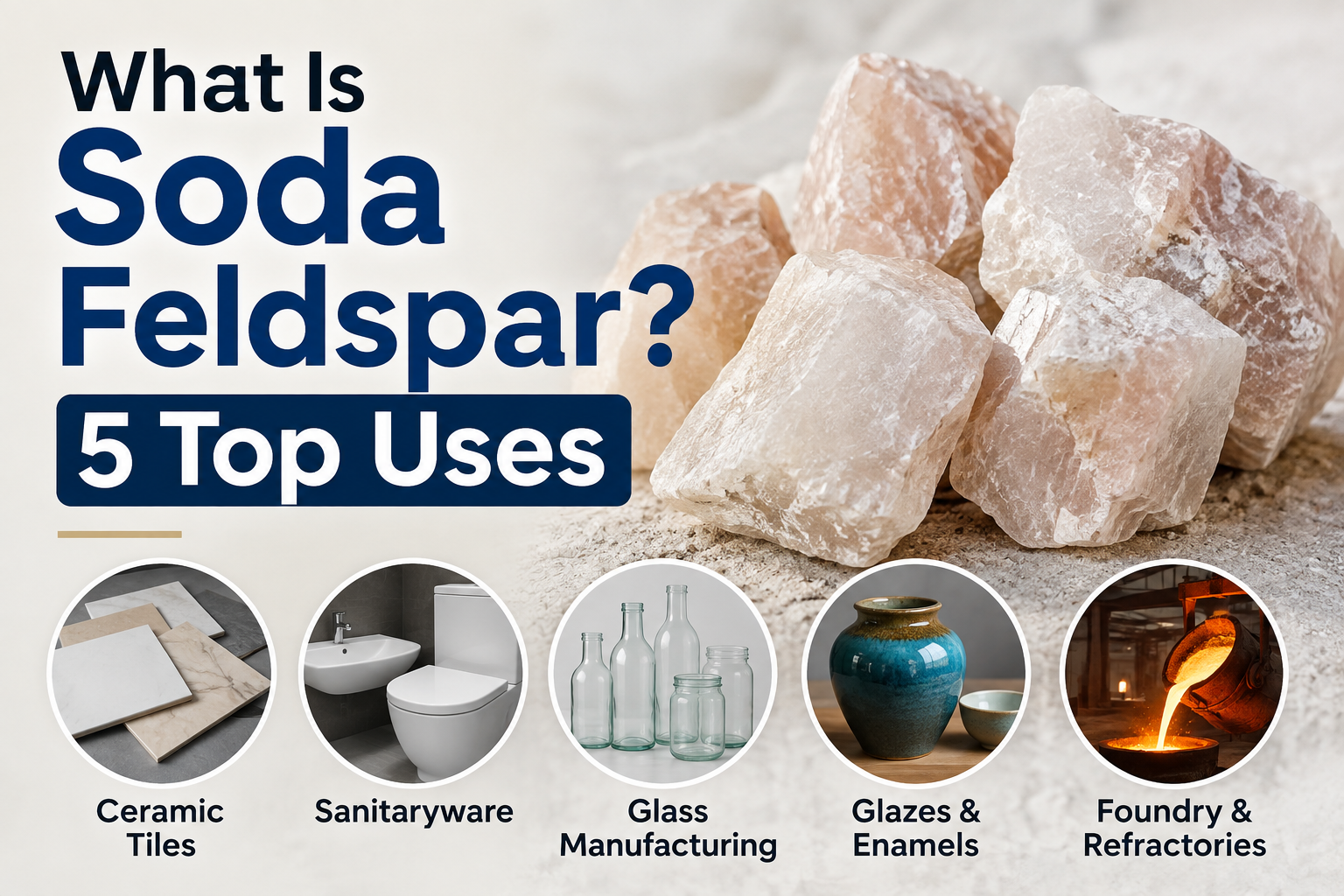
5 Top Soda Feldspar Uses
The key soda feldspar applications are in industries that demand the fluxing effect, alumina content or physical properties. Following are five applications where the material can be of significance.
1. Ceramic Tile Manufacturing
One of the largest uses of feldspar is in the production of ceramics. Soda feldspar is used as a flux in ceramic bodies during firing, where the other raw materials will produce a glassy phase at lower temperatures than otherwise.
The effect of this vitrification process is on the formation of the fired ceramic body. In the case of tile manufacturers, the correct grade of feldspar must be combined with clay, quartz, kaolin, and other materials during the formulation and allowed to perform the required firing behaviour and the end-products requirements.
2. Sanitaryware and Tableware
Soda feldspar is also utilized in the manufacture of ceramics including sanitary ware, and tableware. Here once again its main function pertains to the fluxing and vitrification during firing.
The last formulation should contain a ratio of feldspar and other raw materials of the ceramic in order to attain the desired properties. In repeat production, chemical consistency is particularly relevant since considerable changes in the raw materials can influence the firing behaviour, appearance, or water absorption capacity, or other characteristics of the ultimate ceramic body.
3. Glass Manufacturing
Another important market of feldspar is glass. Feldspar also supplies the batch of glass with alumina and alkalis in the process of glassmaking. The alkali content is a flux, and alumina provides some properties such as hardness, durability, and chemical corrosion resistance.
The chemistry of soda feldspar grade determines its suitability to be used in the production of glass depending on the impurities. An example would be iron content which may be of particular interest in applications where glass colour and clarity are a concern.
4. Ceramic Glazes and Enamels
The use of soda feldspar in ceramic glazes and enamel formulations as a source of fluxing oxides and alumina is possible. It also helps in the formation of the molten glassy phase which forms the final surface in the firing process.
Specification of the feldspar you require will be based on the glaze composition, firing temperature, and the appearance of the feldspar you want as well as other raw materials that you are using.
This is the reason why industrial purchasers ought to consider feldspar based on the actual use and not necessarily on price.
5. Fillers and Industrial Applications
In addition to ceramics and glass, the feldspar minerals may also be utilized as a filler or extender in other products like paints, plastic, and rubber.
Hardness, particle size, chemical stability, and mineral composition are some characteristics that can affect material choice in these applications.
Feldspar is also used in other special forms, such as bonded abrasives. The grade needed in these applications, however, may vary significantly from that needed in ceramic bodies or glass production.
What Determines the Quality of Soda Feldspar?
Not all deposits or grades will perform the same way. When you are buying soda feldspar for industrial use, you need to compare specifications with your application.
Such things as:
- Sodium oxide and total alkali levels
- Silica and alumina levels
- Iron and other impurities
- Particle size or mesh
- Moisture levels
- Whiteness where relevant
- Batch-to-batch consistency
- Firing or melting behaviour
Don’t rely only on a generic specification sheet. Before committing to large-volume purchase, your real formulation and production conditions should be represented by testing.
Soda Feldspar vs. Potash Feldspar
| Factor | Soda Feldspar | Potash Feldspar |
| Primary Alkali | Sodium (Na₂O) | Potassium (K₂O) |
| Common Mineral | Albite | Orthoclase / Microcline |
| Fluxing Action | Strong | More gradual |
| Melting Behaviour | Lower-viscosity melt | Higher-viscosity melt |
| Firing Temperature | Generally lower | Generally higher |
| Vitrification | Faster | More controlled |
| Common Uses | Tiles, glass, glazes | Ceramics, sanitaryware, glazes |
Conclusion
Soda feldspar can resemble another mineral that comes into your production line, but its chemistry can affect the behaviour of your ceramic or glass formulation at elevated temperatures.
The correct material must however have more than the correct name on a specification sheet. You require uniform chemistry, process control, appropriate particle properties, testing and reliable supply.
Expolica Ceramics assists industrial manufacturers in sourcing mineral, mineral processing, laboratory testing, research and development, and quality control which is application-oriented.
It has Soda Feldspar and Potash Feldspar, Ball Clay, Kaolin Clay, Quartz and other ceramic raw materials, in its portfolio. You should not choose soda feldspar by price alone in case your production is dependent on the constant performance of the mineral.
Get in touch with Expolica Ceramics to talk about your application, specifications needed, and supply materials and find the correct material to use in your manufacturing process.
FAQs
Q1. What is soda feldspar?
Soda feldspar is a sodium-bearing aluminosilicate mineral, which is industrially exploited due to its fluxing qualities and provision of alkalis and alumina. It is also essential in the production of ceramics and glass.
Q2. What are the main uses of soda feldspar?
Its main uses include ceramic tiles, sanitaryware, tableware, glass, ceramic glazes, enamels, and some filler or industrial applications.
Q3. What is the purpose of soda feldspar in ceramics?
During firing, soda feldspar is a flux. It helps promote the formation of a glassy phase and vitrification within ceramic bodies.
Q4. What is the difference between soda and potash feldspar?
No. Soda feldspar is mainly sodium bearing whereas potash feldspar is potassium bearing. Their various chemistry influences the melting behaviour and firing behaviour and hence cannot be used as automatically interchangeable.