
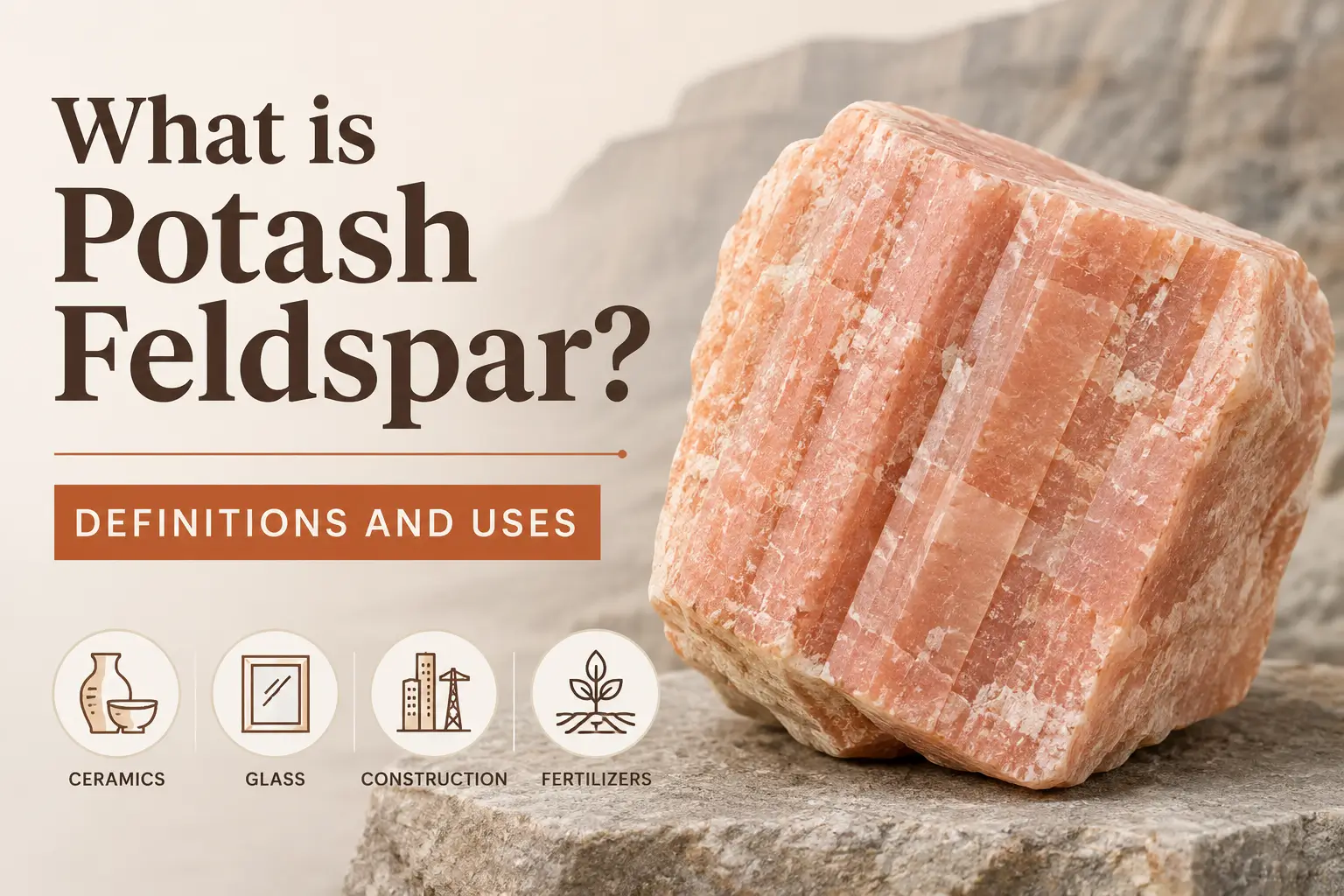
You have likely heard the term Potash feldspar a thousand times, especially when you work in ceramics, tiles, sanitaryware, or glass manufacturing. But the thing is, lots of people use it without knowing exactly what it is or why it is important.
And that is an issue, since the wrong raw material may affect the quality of firing, strength, finish, and even production costs.
In the case of ceramic bodies or glaze formulation, the quality of raw materials will have a direct effect on your end product. It is here that potash feldspar comes in.
It is not just another mineral in the process, but it contributes significantly to the melting behavior and vitrification as well as product durability.
So, have you ever wondered what potash feldspar is, how it works, and in which applications it is used? This guide is a simple explanation.
What is Potash Feldspar?
Potash feldspar is a naturally occurring mineral, which is a member of the feldspar group and has a high proportion of potassium oxide (K₂O).
It primarily consists of potassium aluminum silicate and is a fluxing agent used in the manufacture of ceramics and glass.
Simply stated, potash feldspar helps ensure the material melts and solidifies well at high temperatures, enhancing strength, finish, and structural integrity.
It is commonly employed due to the reduction of firing temperatures and facilitation of vitrification.
Potash Feldspar Definition in Simple Words
Potash feldspar is the substance that makes ceramic and glass products stronger, denser and more resistant in the course of firing.
Many ceramic products could not be heated as hard without it, and they might not reach the same level of finish.
Properties of Potash Feldspar
Knowledge of the properties will help you understand why they are essential to industries.
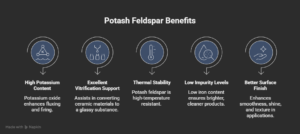
- High Potassium Content: The presence of potassium oxide enhances the fluxing properties and allows for a more complete firing.
- Excellent Vitrification Support: It assists in converting ceramic materials to a solid glassy substance, enhancing strength and durability.
- Thermal Stability: Potash feldspar is high-temperature resistant, hence reliable in industrial production.
- Low Impurity Levels: Low iron content is achieved using high-quality materials, ensuring brighter, cleaner finished products.
- Better Surface Finish: It enhances smoothness, shine and texture in ceramic and glass applications.
Why is Potash Feldspar Important in Ceramics?
The ceramics are highly dependent on controlled melting and bonding during the firing process. It is at this point that Potash feldspar comes in.
It helps in:
- Reducing firing temperature
- Improving body strength
- Enhancing glaze finish
- Increasing product durability
- Supporting dimensional stability
To put it briefly, it streamlines the ceramic production process and makes the end product more efficient and reliable.
Potash Feldspar Uses in Different Industries
Potash feldspar uses extend beyond the field of ceramics. It helps in several industrial applications.
1. Ceramic Industry
This is the largest area of application. Potash feldspar is a flux that assists ceramic bodies in vitrifying well.
Used in:
- Floor tiles
- Wall tiles
- Porcelain
- Sanitaryware
- Tableware
It enhances strength, finish and firing efficiency.
2. Glass Manufacturing
Potash feldspar is used in the manufacture of glass to reduce the melting point and enhance clarity, hardness and longevity.
Benefits include:
- Better transparency
- Stronger glass structure
- Improved melting efficiency
It is used in decorative and industrial glass.
3. Glaze Production
Potash feldspar enhances the texture and consistency of glazes. It helps with:
- Surface smoothness
- Better bonding
- Controlled melting
- Better final appearance
It has a significant contribution to glaze formulation.
4. Paint Industry
It is an effective filler in paints and coatings. Benefits include:
- Better chemical stability
- Improved durability
- Better finish quality
- Welding Electrodes
The mineral composition and heat resistance also make potash feldspar suitable in the manufacture of welding electrodes.
How Potash Feldspar Works in Ceramic Manufacturing
During firing of ceramic products in a kiln, potash feldspar begins to melt, forming a glass phase. The glass phase holds the particles together, forming a more powerful ceramic body.
During firing:
- Lowers the melting point
- Improves bonding
- Reduces porosity
- Increases density
That is why it is regarded as a fundamental ceramic raw material.
Difference Between Potash Feldspar and Soda Feldspar
These two are confused by people.
Potash Feldspar
- Higher potassium content
- More viscous melt
- Better opacity
- The strength of ceramic bodies is improved
Soda Feldspar
- Higher sodium content
- Lower melting point
- Better flow
- Suitable for glossy finishes
The choice between them is influenced by production needs.
How to Choose High-Quality Potash Feldspar?
Feldspar is not all the same. Quality matters.
- Determine Potassium Oxide: An increase in K₂O typically implies improved fluxing performance.
- Check Iron Content: Reduced iron is used to provide clean and brighter fired goods.
- Particle Size Matters: The mesh sizes needed vary according to the applications. For example Coarse to dry press, Fine for porcelain and Ceramic production standard medium.
- Supplier Reliability: Raw material is of consistent quality that guarantees steady production.
Challenges of Using Poor-Quality Potash Feldspar
Poor-quality material may cause severe production problems.
Common problems:
- Uneven firing
- Poor vitrification
- Weak finished products
- Color inconsistency
- Surface defects
That is why the choice of suppliers is crucial.
Why Raw Material Consistency Matters
Consistency in ceramics and glass production directly affects the quality of the output. The slightest difference in mineral composition alters firing behaviour.
It is regular potash feldspar, which guarantees the following:
- Predictable melting
- Better batch consistency
- Lower rejection rates
- Better production efficiency
That is why industrial customers are very concerned about the supply of minerals that are tested for quality.
Conclusion
So you can see just what potash feldspar is and why you should care so much about it in ceramics and industry.
It is not simply a mineral; it is one of the materials at the core, which governs the strength, finish, vitrification, and production efficiency.
In the production of tiles, sanitary ware, porcelain, or glass, the quality of your feldspar is the direct result of your finished product.
That is where Expolica Ceramics a top potash feldspar suppliers in India stands out. With numerous active mines and a focus on mineral quality, Expolica provides high-grade Potash feldspar, controlled for potassium content, low impurities, and stable industrial performance,
for use in the ceramics and manufacturing sectors. The quality of their materials facilitates improved firing, enhanced products, and smooth production processes.
FAQs
1. What is potash feldspar used for?
Potash feldspar is primarily applied in ceramics, glass, glaze, paints and welding electrodes.
2. Why is potash feldspar important in ceramics?
It is a flux that reduces firing temperature and improves vitrification, and enhances product strength.
3. What is the difference between potash feldspar and soda feldspar?
Potassium is more in the potash feldspar, and sodium is more in soda feldspar. They exhibit different melting behavior and usage.
4. Can potash feldspar improve glaze quality?
Yes. It enhances glaze adhesion, flow, and surface finish.
5. How do you identify high-quality potash feldspar?
Verify the supplier’s potassium content, impurities, particle size, and consistency.