
One of the most significant raw materials in the ceramics industry is Clay. The various types of clay are used for different purposes, based on their plasticity, strength, colour, and firing behaviour.
Ball clay is one of them, and it is an important constituent in the production of ceramics, as it is fine in particle size, highly plastic, and binding.
Whether you are into the manufacturing of ceramics, pottery, sanitaryware, or tile manufacturing, you should know what ball clay is and how it behaves during processing.
This article will define ball clay in layman’s language, discuss the characteristics of ball clay, the applications of ball clay, and the reasons why ball clay is such a significant material in contemporary ceramics.
What is Ball Clay in Ceramics?
When considering the meaning of ball clay in Ceramics, we have to be able to get the plain meaning of the term.
Ball clay. This is a fine-grained and highly plastic sedimentary clay, which is composed mainly of kaolinite, with traces of quartz and mica.
It is created by a natural process of weathering and erosion of rocks over a period of millions of years, and the particles of clay are deposited in the sedimentary basins.
Ball clay is not commonly utilized in ceramics. Rather, it is mixed with other types of clays like kaolin to enhance the workability and strength.
Simply put, ball clay is a kind of binder to the ceramic bodies. It enhances plasticity, shapeability, and strength at the pre-firing stage (i.e., before firing).
Formation and Composition of Ball Clay
Ball clay is created in the course of natural geological processes. Over time, eroded materials are carried away by water and deposited in layers. Minute particles are deposited slowly, forming very fine-grained clay deposits.
Typical composition includes:
- Kaolinite (major component)
- Quartz
- Mica
Ball clay is dark in color due to the presence of organic matter. But when burnt at high intensity, it normally turns light in color.
Key Properties of Ball Clay
Its properties are easy to understand, and this explains why it is common in ceramics.
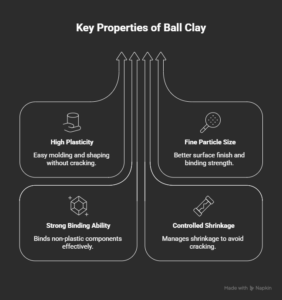
1. High Plasticity
Ball clay is highly plastic; it moulds easily and can be shaped without cracking. This is why it is highly useful in the ceramic forming process.
High plasticity allows:
- Uncomplicated carving at the potter’s wheel.
- Smooth extrusion
- Consistent slip casting
2. Fine Particle Size
The size of the particles in ball clay is very fine compared to several other types of clay.
Fine particles are the cause of:
- Better surface finish
- Improved workability
- Higher binding strength
This is one of the reasons fewer plastic clays are mixed with ball clay.
3. Strong Binding Ability
Ball clay is the natural binder. It binds ceramic bodies of non-plastic components such as silica and feldspar.
This improves:
- Green strength
- Dealing with strength before shooting.
- Difficulty in cracking and drying.
4. Controlled Shrinkage
Despite being plastic, ball clay must be well balanced in a formulation, as it may shrink during drying and firing.
To avoid the cost of lubricants, manufacturers manage shrinkage by incorporating it into alternative materials.
Ball Clay Uses in the Ceramics Industry
We will now examine the uses of ball clays in other ceramic forms. Ball clay is not commonly used in isolation. Rather, it is incorporated into ceramic bodies to enhance performance.
1. Ceramic Tiles
Ball clay enhances the plasticity of tile bodies. It enables the shape of the tile mixture to be formed correctly before firing.
Benefits include:
- Better molding
- Reduced cracking
- Improved mechanical strength
2. Sanitaryware
Toilets, sinks, and washbasins require strong ceramic bodies.
Ball clay provides:
- Smooth surface finish
- Good casting properties
- Improved green strength
Its binding properties ensure that sanitaryware retains its shape before firing.
3. Tableware and Porcelain
In fine ceramics and porcelain, ball clay enhances workability.
It helps:
- Achieve smooth surfaces
- Improve forming consistency
- Increase durability
4. Pottery and Studio Ceramics
In pottery, ball clay is valued for its smooth texture and ease of shaping.
Artists use it to:
- Improve throwing performance
- Reduce cracking
- Enhance body flexibility
5. Refractory Applications
In some refractory bodies, ball clay improves shaping and binding, although fire clay is more commonly used for high-temperature applications.
Why Ball Clay Is Mixed with Other Clays
Ball clay alone can shrink excessively during drying and firing. Therefore, it is blended with:
- Kaolin (for whiteness and strength)
- Feldspar (for vitrification)
- Silica (for structural stability)
The balance of materials ensures:
- Controlled shrinkage
- Proper firing behaviour
- Desired colour and finish
This combination creates high-performance ceramic bodies.
Advantages of Using Ball Clay in Ceramics
Ball clay is highly valued in ceramic production due to its exceptional physical and chemical properties.
Its use is not only another raw material, it also improves the process of shaping, its strength and the quality of the final product. These are the main benefits as explained below.
1. Superior Plasticity
One of the biggest advantages of ball clay is its high plasticity. This means it can be easily molded and shaped without cracking.
High plasticity allows:
- Smooth wheel throwing
- Better extrusion performance
- Improved slip casting behavior
This makes forming processes easier and more consistent.
2. Strong Binding Capability
Ball clay acts as a natural binder in ceramic bodies. It holds together non-plastic minerals such as silica and feldspar.
As a result:
- Green strength improves
- Products are easier to handle before firing
- Breakage during drying is reduced
This binding ability is crucial for manufacturing stability.
3. Fine Particle Size and Smooth Finish
Because ball clay has extremely fine particles, it contributes to a smoother surface texture.
This leads to:
- Better surface finish
- Improved glaze application
- Enhanced final appearance
How to Select Reliable Ball Clay Suppliers
Selecting the right supplier ensures product consistency.
When evaluating Ball Clay suppliers, consider:
- Quality certifications
- Chemical composition reports
- Consistency across batches
- Delivery reliability
- Technical support
Conclusion
It is important to know what ball clay is in Ceramics before any person dealing with ceramic manufacturing, pottery, or any industrial use of clay.
Ball clay is a very plastic fine-grained sedimentary clay that enhances the workability, binding strength, and finish of the surface of the ceramic bodies.
It is not commonly used as an independent material, but it is very important when mixed with kaolin, feldspar, and silica.
With tiles, sanitaryware, porcelain, and pottery, the applications of ball clay are common in the ceramics industry.
Its plasticity and green strength, which help to increase shaping and forming processes make it invaluable.
High-quality material should be selected, and Ball Clay suppliers should be reliable to ensure consistent performance, improve product quality, and avoid production issues.
Ball clay remains one of the most valuable raw materials used in modern ceramics.